
 Vouchers / Music
 Merch store
 Overview
 Big Molimo AK
 Gilbert Bishop
 Einwelt
 DGS
 Artist Talk
 Erich Kanli
 Grosses K
 D.O Double Dars
 Speaker
 Singer Female
 Singer Male
 Rapper
 Internship
 Internship AI artist
 Music producer
 Copywriter
 Dancer
Uncategorized
Band Recording in a Studio: How to Prepare Your Session
 AI
Oct
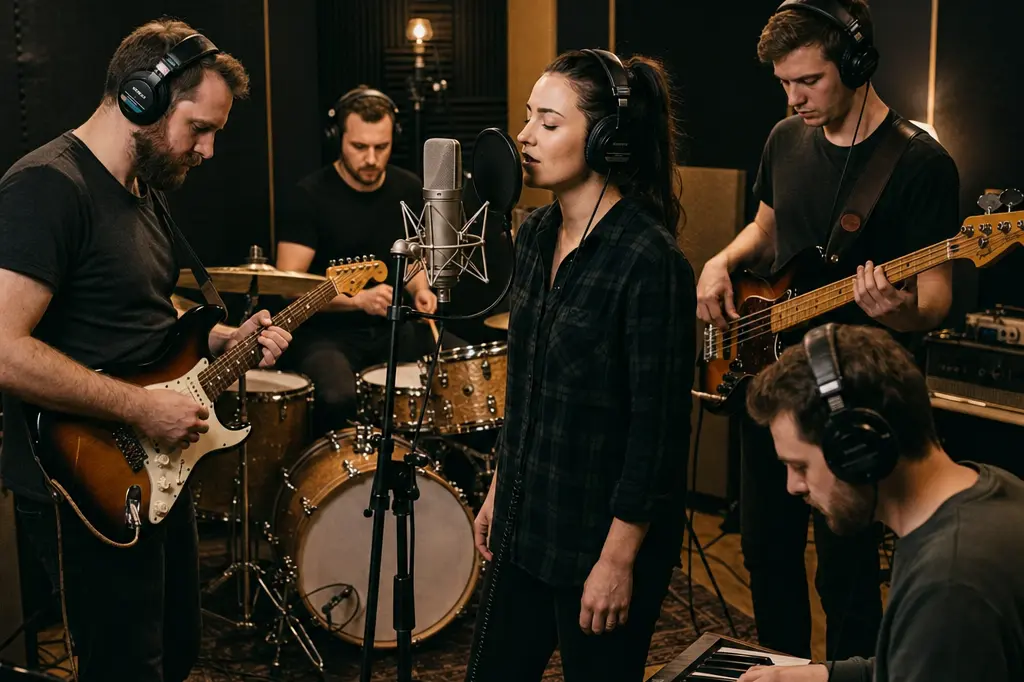
You have played together for two years, the songs are finished, and at some point someone says it: “We should record this properly.” That is where the part most bands underestimate begins. A band recording is not an extended rehearsal with better microphones — it is an appointment with a clock, and your preparation decides how much music comes out of it.
This article covers what to settle before the session, how a studio day actually runs and what you hold in your hands afterwards.
In short
- Three packages: 90 minutes (€149), half a day with 4 hours (€399), a full day with 8 hours (€699). All three package prices include 19% VAT.
- Included: briefing, sound engineer, effects and mixing, multichannel and surround mix, and all tracks as a download.
- Package size caps the line-up: 3 members (Basic), 4–5 (Pro), 5 (Ultra); each additional person €10.
- Recording happens in three spaces: a 45 m² main room plus two booths.
- A drum kit can be rented from €29 (Trak System III).
- Mastering is €99 per song, video capture €49, €99 or €149 depending on the package.
- Bookable around the clock by arrangement.
Playing Live Together or Track by Track? The Decision Before Everything Else
This is the one question you should not leave to the studio, because it shapes your whole day.
Live together. Everyone plays at once, every instrument has its own microphone and its own track. The studio is built for it: a 45 m² main room and two separate booths, so drums, amps and vocals sit apart. Upside: the interplay is real, the tempo breathes, and you are finished after a few passes. Downside: one mistake in one track can cost the whole take, because the microphones hear each other.
Track by track. Drums and bass first, then guitars, then vocals. Upside: every track is clean and corrections are easy. Downside: it takes considerably longer, and it does not fit into a 90-minute package.
The practical recommendation: record the foundation live — drums, bass, rhythm guitar — and add vocals and solos afterwards as overdubs. That keeps the interplay and gives you control over the two tracks people notice most.
Tell the studio your decision when you book, not at the soundcheck. Room preparation and headphone routing depend on it.
Which Package Fits Your Line-Up
| Package | Time | Price | Band members |
|---|---|---|---|
| Basic | 90 minutes | €149 | 3 |
| Pro | 4 hours (half day) | €399 | 4–5 |
| Ultra | 8 hours (full day) | €699 | 5 |

Every person above the package size costs €10. That is cheap enough not to hide — but you have to say so in advance, because every extra person needs a headphone feed and a mix.
How many songs fit into a session depends on your preparation — the service page gives no figure, and neither will I. What is certain: briefing and soundcheck cost time in every session, and 90 minutes are nearly gone after the first usable pass. If this is your first time in a studio, four hours mainly buy you calm.
Band Recording: How a Session Runs, Hour by Hour
Here is what half a day looks like when it goes well:
| Time | What happens |
|---|---|
| 0:00–0:20 | Arrival, setup, unpacking and tuning |
| 0:20–0:50 | Briefing, microphone placement, positions in the main room and booths |
| 0:50–1:20 | Soundcheck, individual headphone mixes for every person |
| 1:20–2:50 | Recording: passes, takes, short listening breaks |
| 2:50–3:30 | Overdubs: vocals, solos, doubles |
| 3:30–3:50 | Listening back, choosing takes |
| 3:50–4:00 | Teardown, agreeing on file handover |

Two things in that table matter more than the rest.
First, the soundcheck. The half hour spent on headphone mixes feels like lost time and is the best investment of the day. If the drummer cannot hear the bass, the tempo will drift — and you will hear it in every take that follows. The equipment list names six headphone amplifiers and a personal monitor mixer, so individual mixes are possible. Use that instead of agreeing on a compromise.

Second, the listening breaks. Listen back together after the second pass, not only at the end. Correcting a decision after twenty minutes is cheaper than after two hours.
Song List and Arrangement: What Has to Be Settled First
Bring a list that states three things for every song:
- Tempo in BPM — even if you play without a click. Knowing the tempo is how you notice it running away.
- The structure in bars or sections: intro 4, verse 16, chorus 8, and so on.
- Who comes in when, and who stops. The most common reason for an aborted take is not a wrong note but an unclear ending.
Also fix the order in which you want to record — and put your second-best song first. The first take of the day is rarely the best one; do not burn the piece everything builds towards on it.
One more point that likes to surface on the day: settle arrangement questions beforehand. Whether the second guitar doubles in the chorus is a band question, not a studio question. In the studio that discussion costs twenty minutes; in rehearsal it costs nothing.
Instruments: The Part the Studio Cannot Fix
Microphones, preamps and the room are there. What is not there is the condition of your instruments. The checklist:
- New strings — but not on the day. Fit them one or two days earlier and play them in. Fresh strings keep slipping out of tune for the first few hours.
- Drum heads. Worn batter heads sound dull and will not tune. If you fit new ones, do it a few days ahead as well.
- Tune, then tune again. Before every take. Every band underestimates this.
- Batteries. Active pickups, pedals, wireless systems — bring fresh ones, do not hope.
- Cables, twice over. A crackling jack lead costs more studio time than any other component.
- Tuner, spare picks, string winder, drum key. The small items every day needs.
Drums: Bring Your Own or Rent?
Either works. The studio offers a kit for rent from €29 (Trak System III), and for a first session that is usually the better choice: it is already there, already miked, and setting it up costs you no time.
If you still want to bring your own, bring only the parts that define your sound — usually snare, cymbals and pedal. Building and tuning a complete kit easily costs an hour compared with using the house kit, and that hour comes out of your recording time.
Either way: say in advance whether you need a kit.
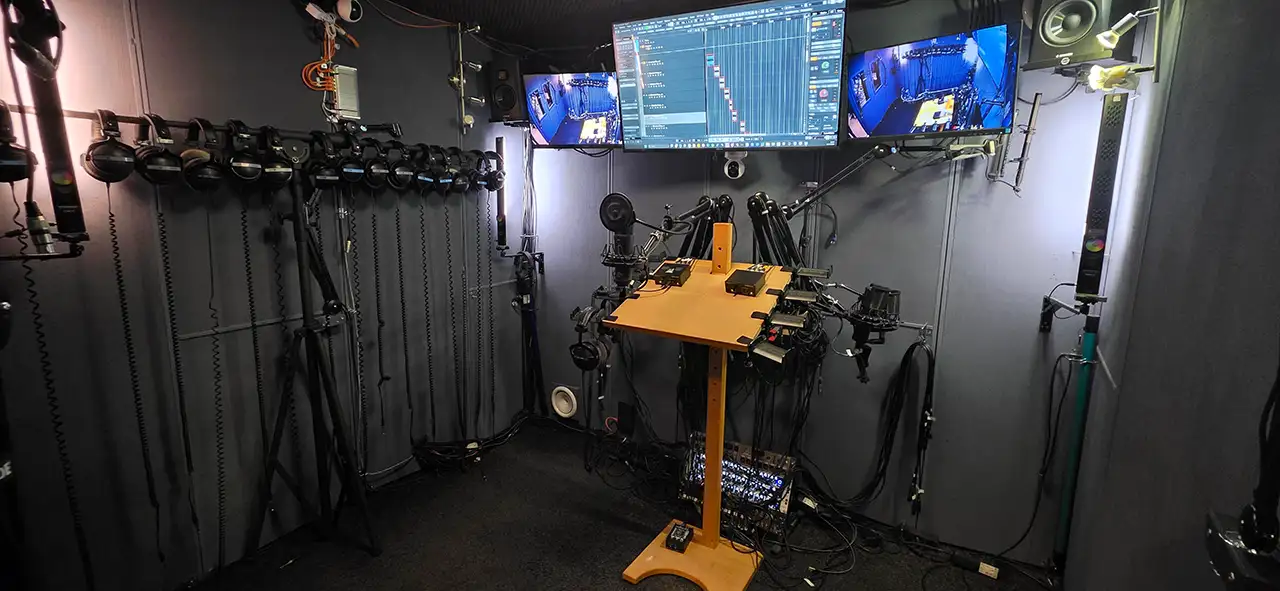
That is in the FAQ on the service page too, and there is a practical reason — setup and microphone placement happen before you arrive, not after.
Click, Headphone Mix and Communication
Three small decisions that shape the day:
Click or no click. With a metronome, overdubs drop in cleanly and tracks can be swapped later. Without one, the music breathes more. If you plan overdubs, take the click — but rehearse with it at least twice beforehand. A click a band hears for the first time in the studio is an obstacle, not an aid.
The headphone mix is personal. Everyone needs something different loud: the drummer needs bass, the singer needs their own voice and the chords, the bassist needs kick drum. Say it specifically — “more kick, less guitar on the left” helps; “something feels off” does not.
Communicate with signals. Playing in headphones, you cannot hear each other the way you do in the rehearsal room. Agree on two hand signals in advance: stop, and from the top. That saves several seconds of confusion per take.
What You Have Afterwards
According to the service page, all three packages include briefing, a sound engineer, effects and mixing, a multichannel and surround mix, and all tracks as a download. The formats given are WAV and MP3.
Three notes on that:
- “All tracks” is more than you need at first — and that is exactly why it is valuable. With the individual tracks you can have a new mix made later without recording again. Back them up twice, ideally on the evening of the session.
- The surround mix is an addition, not a replacement. 5.1, 7.1 and 11.1 Dolby Atmos are named. Streaming platforms still need a stereo version — make sure you get one.
- Mastering is not in the package. It costs €99 per song. What mastering does and does not do is covered on the audio mastering page; the mixing stage has its own page under audio mixing.
If you also want material for social media, video capture of the session is bookable — €49 with Basic, €99 with Pro, €149 with Ultra.
From Recording to Release
Two points that have nothing to do with technology and still need settling before you release:
Register your own songs. When your songs are used publicly, the rights of composers, lyricists and publishers in Germany are administered by GEMA. Music on physical media — CD, vinyl, mixed products — has its own licensing route there (GEMA, music use on physical media, in German), and online use has another (GEMA, music use on the internet, in German).
Be registered as performers. The performers’ side — your playing on the recording — is administered not by GEMA but by GVL (GVL for artists, in German). Anyone not registered there receives no distribution for radio and streaming use of their own recording.
Cover songs are a separate case. Recording and releasing someone else’s piece needs a licence. The studio has its own page for this: cover song / karaoke.
Common Mistakes – and How to Avoid Them
- Booking too short. 90 minutes is one song if it is tight — not a three-track demo.
- Changing strings and heads on the day. One or two days earlier, then played in.
- Taking arrangement questions into the studio. That discussion belongs in rehearsal.
- Cutting the soundcheck short. Every minute here saves several during recording.
- Hearing the click for the first time in the studio. Rehearse with it or play without it.
- Not announcing the drum kit. House kit and microphone placement need lead time.
- Recording your best song first. The first take of the day is a warm-up.
- Not backing up the tracks. The download is a delivery, not an archive.
FAQ – Frequently Asked Questions About Recording With Your Band
What does a session with the band cost? According to the service page the packages are €149 (90 minutes), €399 (4 hours) and €699 (8 hours). Individual quotes are available on request.
How many band members can record at the same time? In the 45 m² studio with two booths, up to five band members can record simultaneously according to the service page. Larger line-ups need to be arranged. Every person above the package size costs €10.
Can we rent a drum kit? Yes, from €29 (Trak System III). Say when you book whether you need one.
Is mixing included in the price? Yes. Effects and mixing plus a multichannel and surround mix are included in all three packages according to the service page. Mastering is separate at €99 per song.
Do we get the individual tracks? Yes, all tracks are included as a download; WAV and MP3 are named.
How long does a session take? Depending on the package, 90 minutes, four hours or eight hours.
Can we record at night or at the weekend? The studio states that it is bookable around the clock. That is an arrangement rather than a standard slot — ask about your preferred date specifically. Office hours are Mon–Fri 09:30–19:00 and Sat 10:00–19:00.
Which styles do you record? The service page describes genre-independent work and explicitly lists rock, metal, jazz, pop, indie and classical.
Can we have the session filmed? Yes, video capture is bookable: €49 (Basic), €99 (Pro), €149 (Ultra). For a separate clip there are also the music video and making of pages.
What if only one person wants to record something? Then this is the wrong package. For single instruments there are guitar recording, piano recording and instrumental recording; for voice, vocal recording. What to bring for a vocal session is covered in Vocal Recording in a Studio: What to Bring.
Should we send a demo in advance? It helps. A phone recording from rehearsal is enough to judge tempo, line-up and balance. Send it with your enquiry.
What if a take does not work? Then it gets repeated — which is why scheduling matters more than perfection. Plan several passes per song, not one.
Your Session in Munich
Once the date, the line-up and the song list are settled, book directly through online booking. For larger line-ups, night sessions or an individual quote, use the contact form — state your line-up, the number of songs, whether you need a drum kit and whether you want to record live or in overdubs.
All packages and add-ons are detailed on the band recording page, and the full equipment list is under technical data. The studio is at Westendstraße 177, 4th floor, 80686 Munich — location and directions.
Book or enquire about a session
Once the date, line-up and song list are settled, you can book directly through the online booking. For larger line-ups, night sessions or an individual quote, use the contact form and state your line-up, the number of songs, whether you need a drum kit and whether you record live or in overdubs.
Location & Getting There
The studio is at Westendstraße 177 in Munich, a few minutes’ walk from the Westendstraße underground station.
Address
SOUNDSTARSTUDIOS – Recording Studio Munich
Westendstraße 177, 4th floor
80686 Munich, Germany
Getting there
Underground: U4 or U5 to Westendstraße
Tram: line 18 to Westendstraße
Bus: 130 or 157 to Westendstraße, 62 to Elsenheimerstraße
Timetables and disruptions: MVG Munich
Arriving with instruments: the studio is on the fourth floor. There are no dedicated customer parking spaces – if you arrive with amps and a drum kit, look for public parking nearby and allow time for unloading. It is best to arrange a delivery in advance.
Plan your route · Location page
Sources
- SOUNDSTARSTUDIOS: Band recording (service page, retrieved 27 October 2026)
- SOUNDSTARSTUDIOS: Technical data (retrieved 27 October 2026)
- GEMA: Music use on physical media (retrieved 27 October 2026)
- GEMA: Music use on the internet (retrieved 27 October 2026)
- GVL: Information for performing artists (retrieved 27 October 2026)
Last Updated on 28/10/2026 by SOUNDSTARSTUDIOS
